
From Days to Dollars
In The DSO Decade-Long Creep, we argued that Days Sales Outstanding has structurally deteriorated over the past ten years, pushing suppliers into the role of Hidden Bankers for their own customers. That piece measured the problem in days. This one measures it in dollars, and the timing could not be worse for the companies carrying the balance.
1. Industry Trends: 2015 vs. 2025
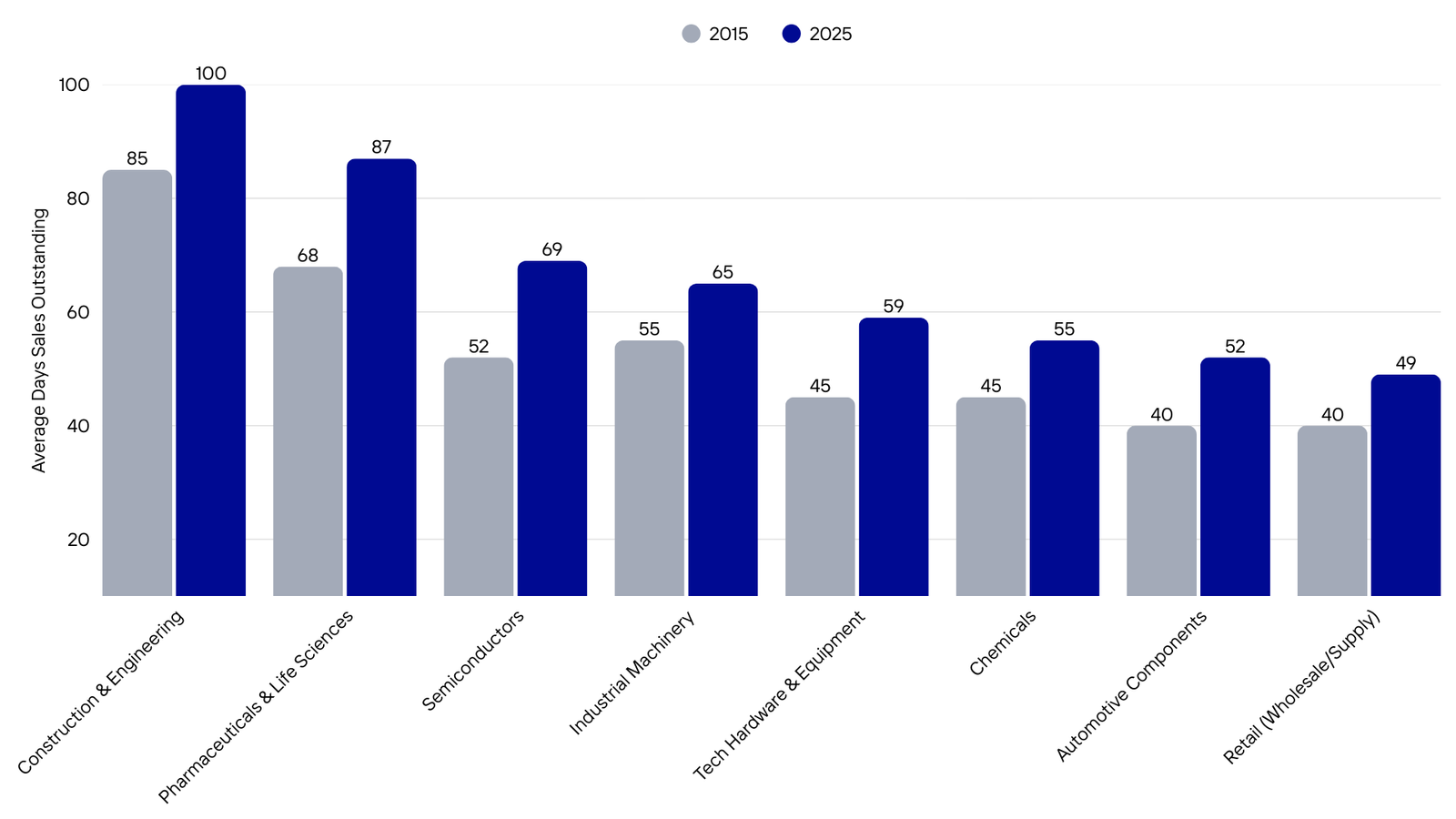
Every sector moved the wrong way. The question is what those extra days now cost.
2. The Cost of Carry Has Roughly Doubled
Interest rates in 2026 are high and climbing. The Federal Reserve held its target rate at 3.50% to 3.75% through its July meeting, but its own projections, revised upward in June, now point to a year-end range of 3.6% to 4.1%, with two more hikes priced in before December. For a company financing its balance sheet with a revolver or term debt, the cost of every dollar tied up in unpaid invoices has roughly doubled since the near-zero rate era that defined the first half of the last decade.
3. What a DSO Slip Costs You
The math below shows what that means for a representative mid-market manufacturer or distributor: a 15-day DSO slip, from 55 to 70 days, ties up roughly $4.1 million in additional receivables per $100 million of revenue, and carries about $411,000 a year in real financing cost at a 10% cost of capital.
4. Domeo's Solution
The fix isn't "collect faster." It's giving the finance team better tools than an aging report and more coverage than a few overworked collectors can manage.
- Athena AI. Practical AI that handles the manual, repetitive work, freeing up your team's time and increasing productivity. We believe human in the loop plus AI delivers the best outcome.
- Data-driven insights. Go beyond the AR aging report. Give the team a real view into customer accounts, ranked by risk and dollar impact, so a lean finance team collects like a much larger one.
- Invoice delivery. The lowest-hanging fruit in the whole process. Most midmarket companies assume their ERP delivered the invoice. Often the recipient never got it into their AP system to be processed, and that gap alone accounts for a meaningful share of "slow" payers who were never actually disputing anything.
- Customer communication. Reach 100% of customers, not just the largest past-due balances, with consistent messaging and a consistent rhythm. Keep a person in the loop for the relationship and the exceptions, and automate everything else.
- Grow with healthy customers. Work with sales to resolve slow payment or over-limit accounts before they scale. Revenue growth that compounds credit risk isn't growth, it's a deferred write-off.
Domeo's clients see a 20% to 25% reduction in DSO and 2x to 3x more collections capacity from the same finance team. For a midmarket CFO, it's hard to find a higher-ROI investment in the office, and it's worth a line item in next year's budget.